
What happens when we transfer objects?
Track both groups when objects move between them, then compare the total and equality.
A little 3D thinking lab
Move an apple. See what changes.
Make a guess, watch the apples, then explain why. Every scene uses ten apples or fewer.
If Lele gives Mingming one apple, will they have the same number?
Before · Lele has 4 apples. Mingming has 2.
What the picture shows: The apples belong to A and B; count each side first and check whether the selected action adds, removes or transfers apples.
Try this: Choose a scenario, predict who will have more, then select Play; pause if needed and compare the before-and-after table below.
What to notice: A transfer changes the owner without changing the total; adding the same number to both sides leaves their original difference unchanged.
Choose “Play 3D animation” to open the model and watch the change in one step.
Choose a guess, then watch. You can also watch first.
Reduced motion is on. Results appear without movement. Choose “Play animation once” if you want to watch the movement.
Explain what happened
| In each tray | A · Lele | B · Mingming |
|---|---|---|
| Before | 4 | 2 |
| After | — | — |
- Altogether
- 6
- Difference
- 2
Drag to turn, use the view buttons, or focus the model and press arrow keys. Home resets the view.
Related practice
-
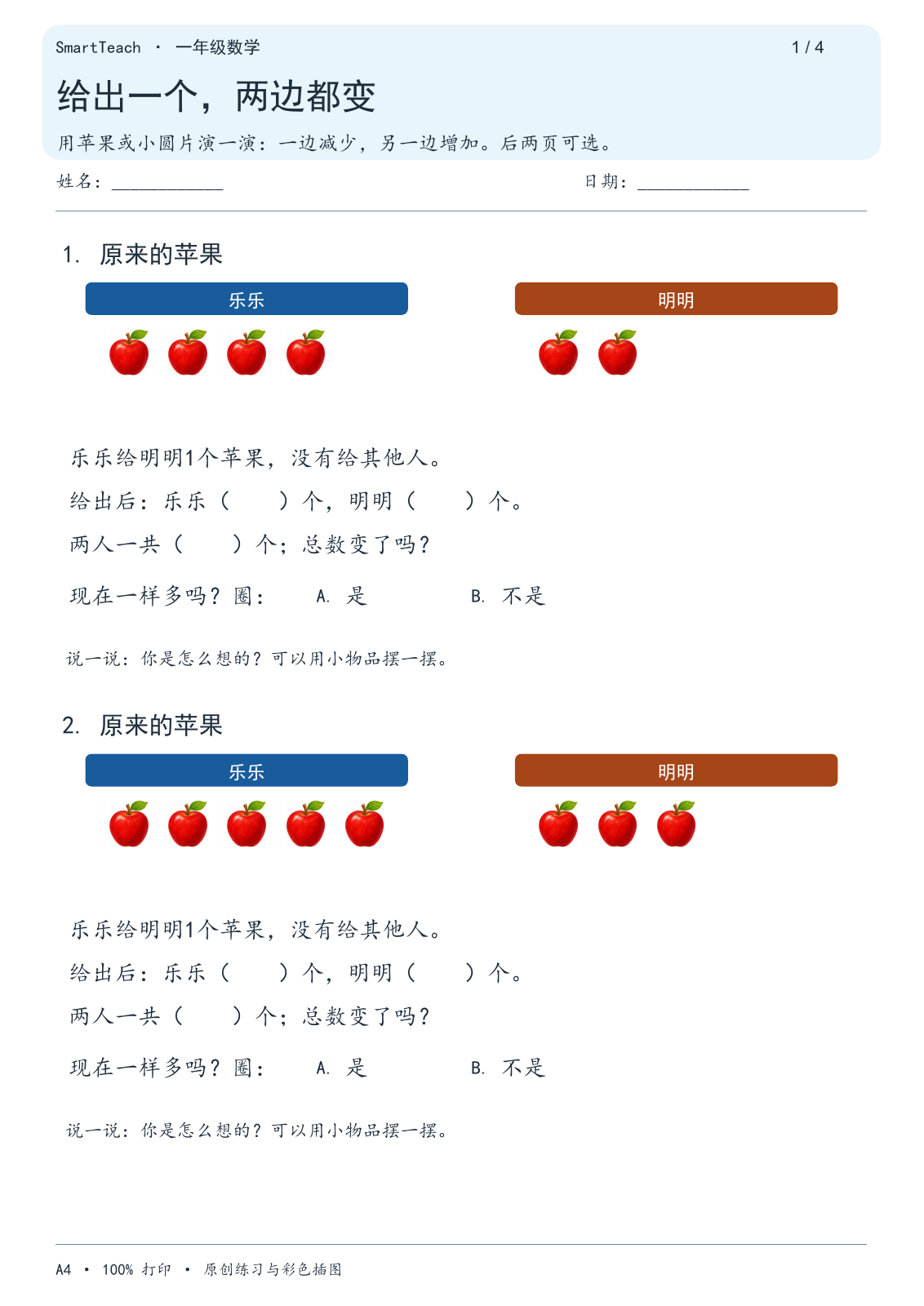
What happens when we transfer objects?
Focus on pages 1, 2, 3, 4
Four color thinking sheets, with optional challenges on the last two pages. Adults may read aloud; oral answers are welcome. Separate answers and discussion notes included.
View the complete workbook