
What happens when we transfer objects?
Four color thinking sheets, with optional challenges on the last two pages. Adults may read aloud; oral answers are welcome. Separate answers and discussion notes included.
- Grade
- Grade 1
- Topics
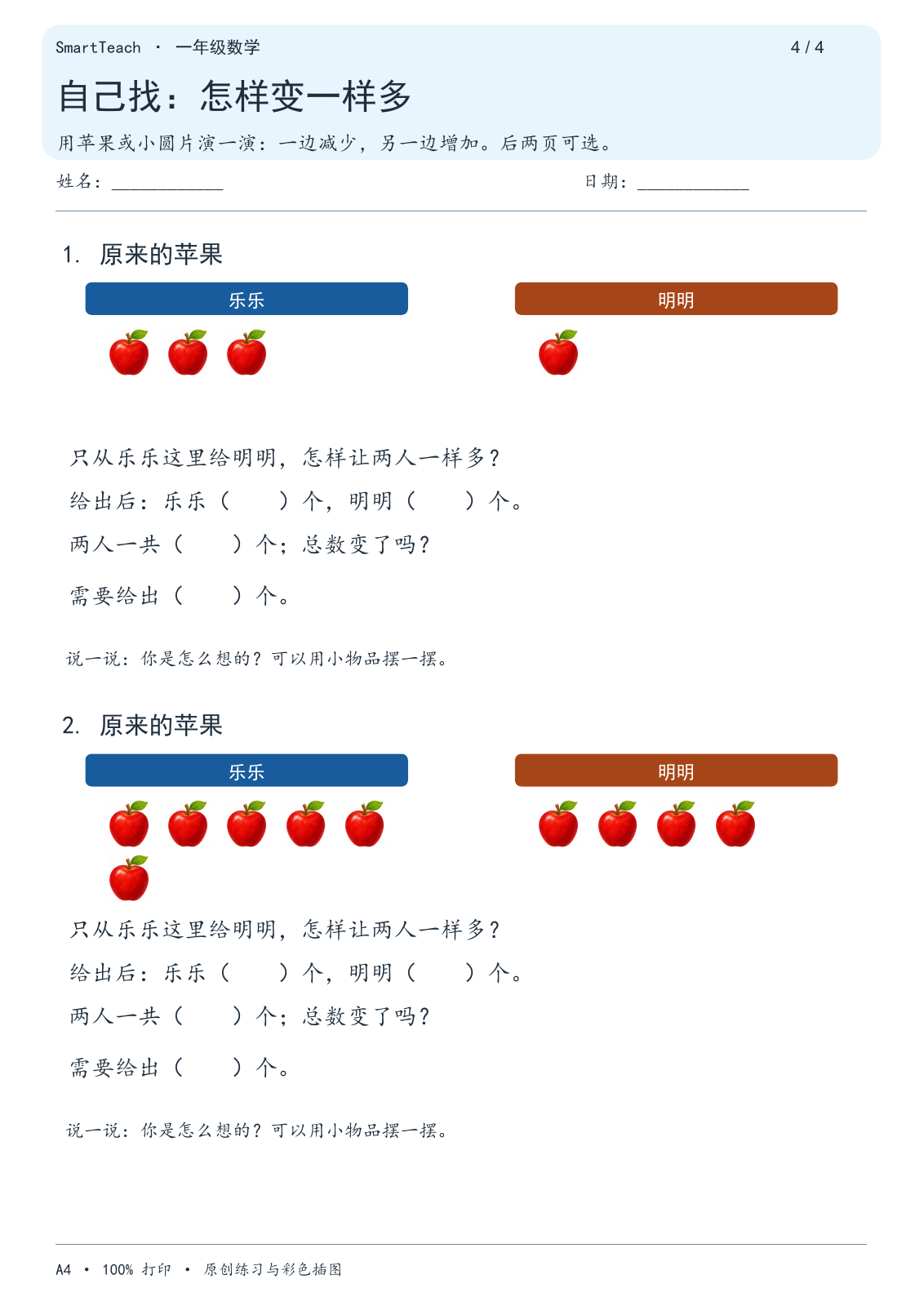
- One loses, one gains · The total stays the same · Are the groups equal? · Make the groups equal
- Material language
- Simplified Chinese
Learning goal
Understand first, then practise
Learning goal
This page focuses on What happens when we transfer objects?: One loses, one gains, The total stays the same, Are the groups equal?, Make the groups equal. Record each condition, use an ordered method to try, rule out or work backwards, and explain why the answer satisfies every condition.
Check before starting
The learner can identify the objects, quantities and changes. An adult may read longer text aloud without choosing the answer.
Work through an example
- Start with eight on the left and four on the right; total twelve.
- Transfer two from left to right and record six and six.
- Check 6 + 6 is still twelve and explain why the groups are equal.
A common mix-up
A transfer subtracts on one side and adds on the other; subtracting from both does not preserve the total.
A useful adult prompt
Instead of giving the answer, ask: “Which clue have you used? Which clue still needs checking?”
How to use this lesson
Read the explanation, use any interaction or video already on this page, then complete the worksheet and check the explanation.
Curriculum basis and scope
The standards below support the learning goals and sequence. SmartTeach independently wrote the web explanation, example and prompts for this resource. Choose worksheets to match the learner’s school progress.
- 《义务教育数学课程标准(2022年版)》第一学段
- Number sense, simple whole-number operations, sorting, directions, solid shapes, and solving simple problems from everyday contexts.
A little 3D thinking lab
Move an apple. See what changes.
Make a guess, watch the apples, then explain why. Every scene uses ten apples or fewer.
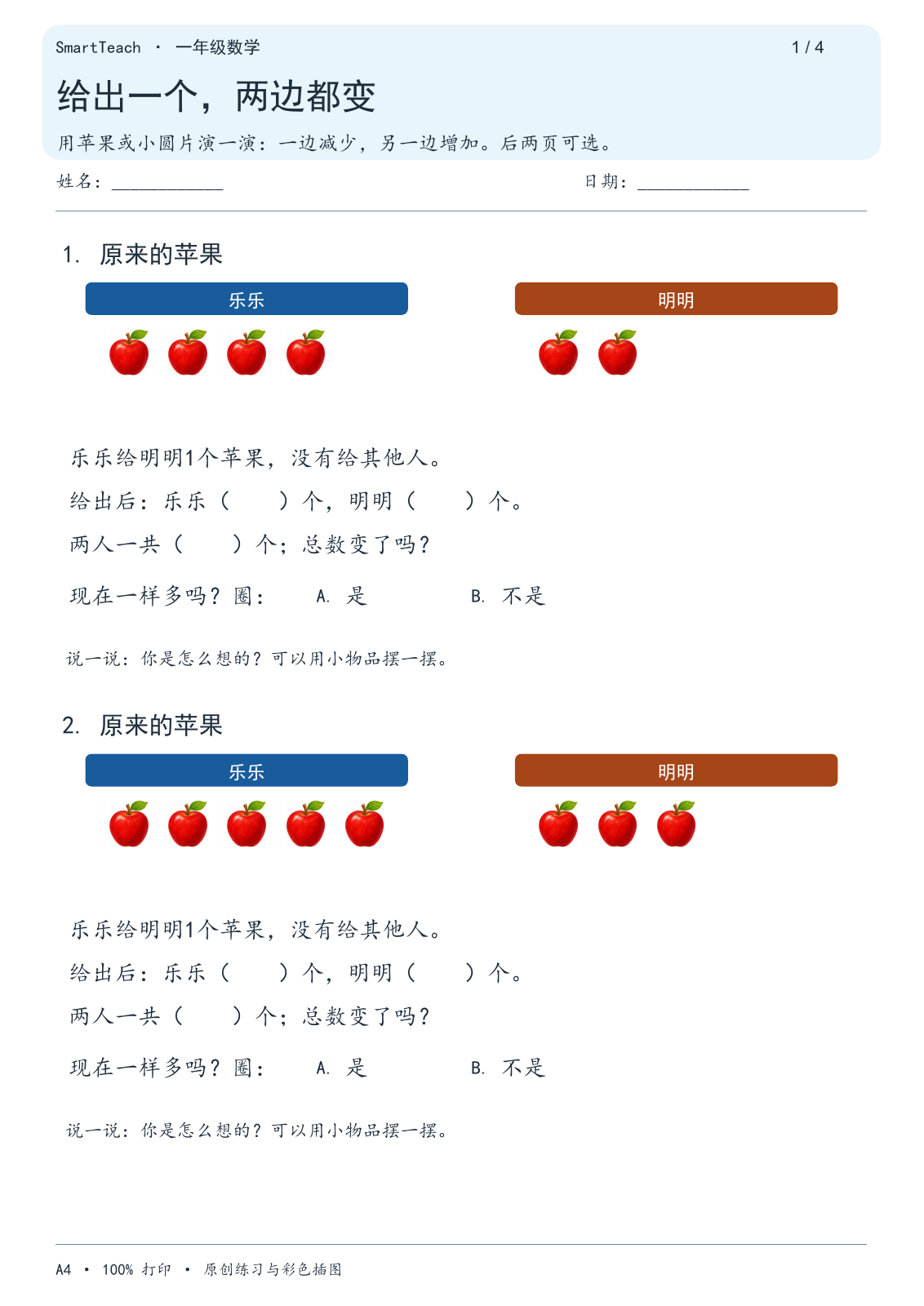
If Lele gives Mingming one apple, will they have the same number?
Before · Lele has 4 apples. Mingming has 2.
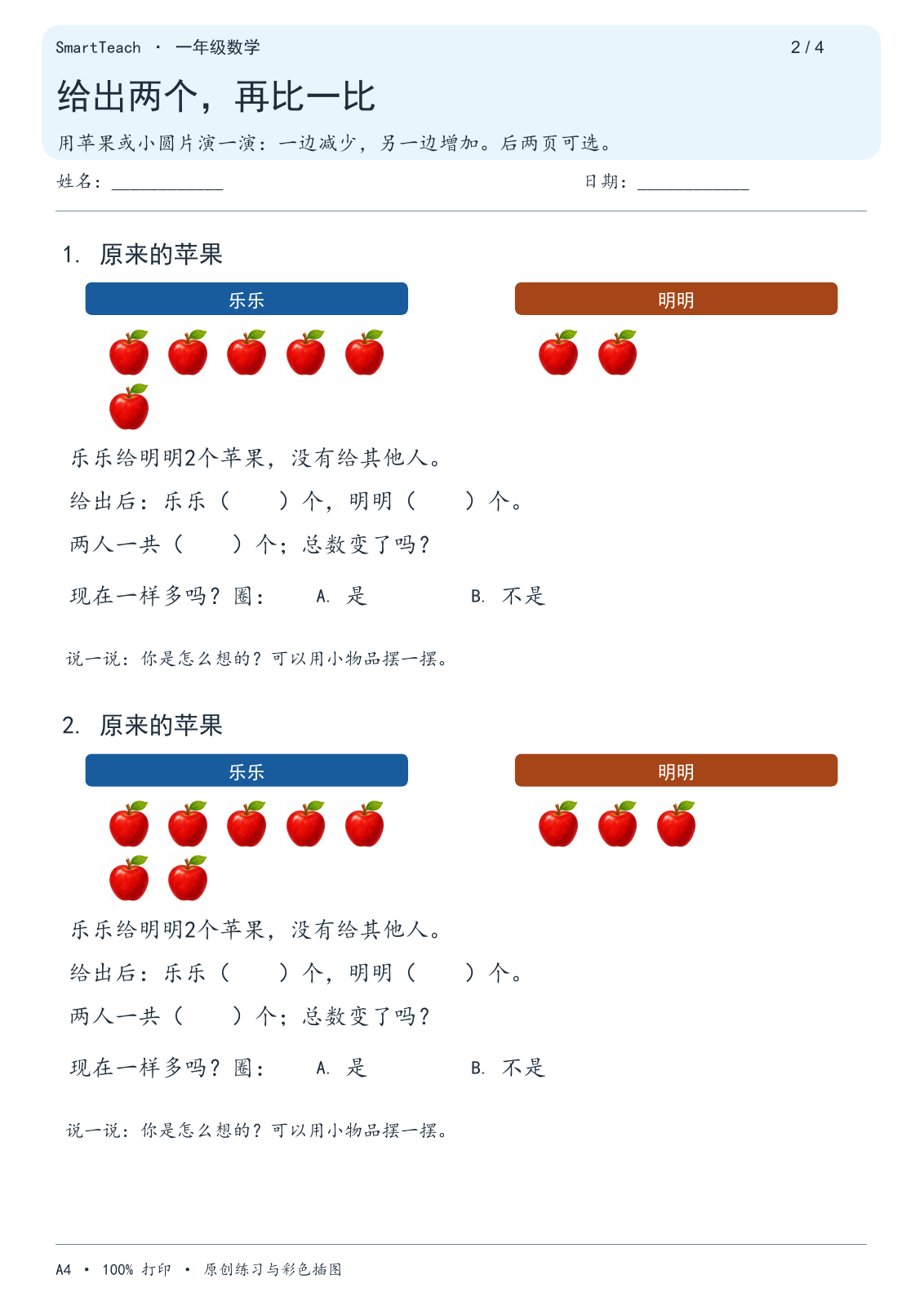
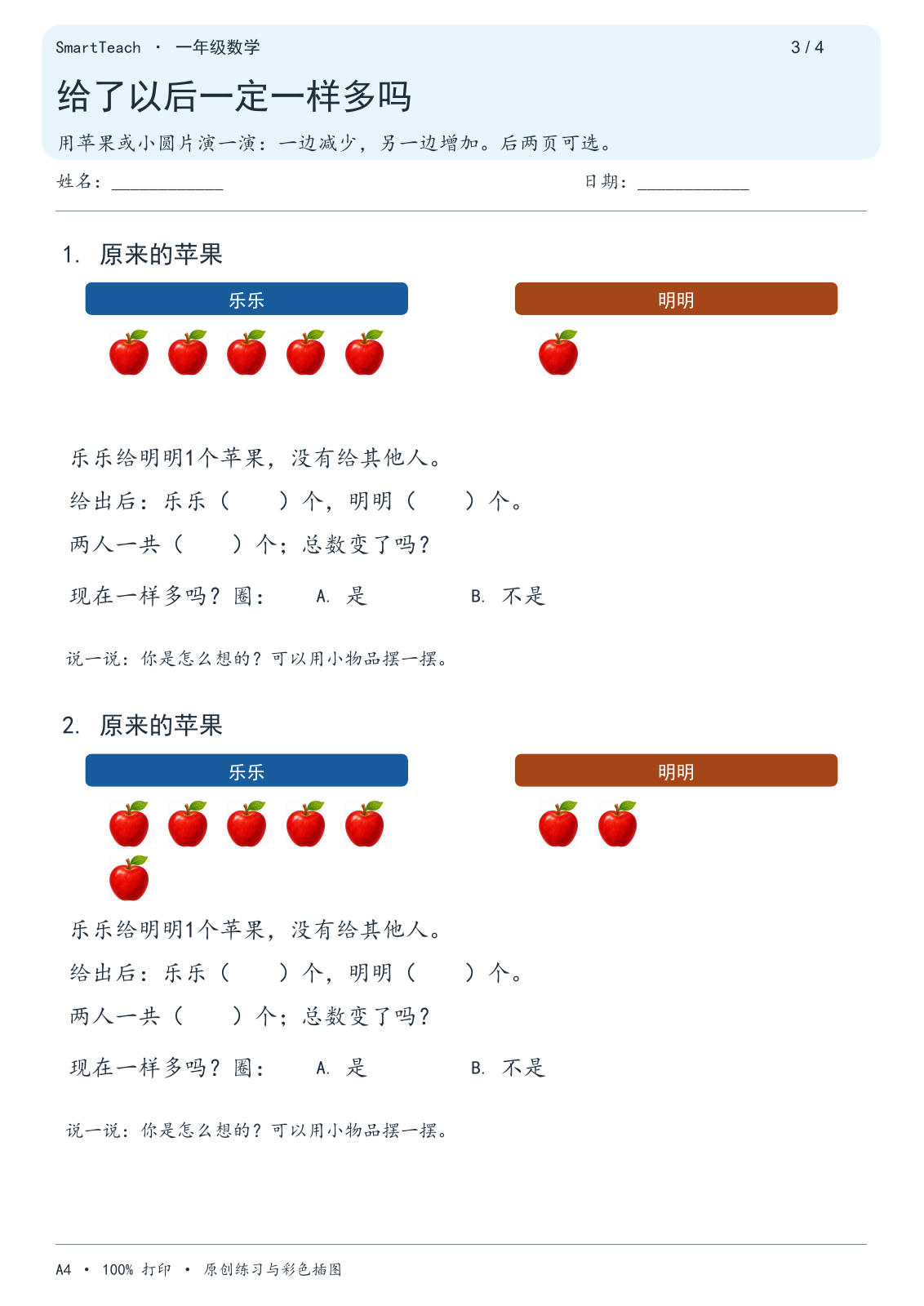
What the picture shows: The apples belong to A and B; count each side first and check whether the selected action adds, removes or transfers apples.
Try this: Choose a scenario, predict who will have more, then select Play; pause if needed and compare the before-and-after table below.
What to notice: A transfer changes the owner without changing the total; adding the same number to both sides leaves their original difference unchanged.
Choose “Play 3D animation” to open the model and watch the change in one step.
Choose a guess, then watch. You can also watch first.
Reduced motion is on. Results appear without movement. Choose “Play animation once” if you want to watch the movement.
Explain what happened
| In each tray | A · Lele | B · Mingming |
|---|---|---|
| Before | 4 | 2 |
| After | — | — |
- Altogether
- 6
- Difference
- 2
Drag to turn, use the view buttons, or focus the model and press arrow keys. Home resets the view.
All 4 pages
For printing, use A4 at 100% scale and print single-sided.