
Explore and sort solid shapes
Rotate four solids, explore their features and everyday examples, then watch a Chinese narrated explanation. Includes four original worksheets and parent answers.
- Grade
- Grade 1
- Topics
- Sphere, cuboid, cube and cylinder · Everyday objects · Sorting and counting · Rotatable 3D models
- Material language
- Simplified Chinese
Learning goal
Understand first, then practise
Learning goal
This page focuses on Explore and sort solid shapes: Sphere, cuboid, cube and cylinder, Everyday objects, Sorting and counting, Rotatable 3D models. Read quantities or positions in a picture, explain the action, then record it with numbers, symbols or shapes.
Check before starting
The learner can point and count one item at a time and identify whether the question asks about a total, position, change or shape. Oral answers are fine.
Work through an example
- Observe a tissue box, block, can and ball as complete real objects.
- Match them to cuboid, cube, cylinder and sphere, noting flat surfaces and whether they roll.
- Rotate the 3D model and check the class from another view instead of using one outline.
A common mix-up
A circle is 2D and a sphere is 3D; a cylinder does not become a circle because its top view is round.
A useful adult prompt
Ask: “What does the picture tell us? What must we find? How can you check it in the picture?”
How to use this lesson
Read the explanation, use any interaction or video already on this page, then complete the worksheet and check the explanation.
- 1Read the explanationClarify the goal, example and common mix-up.
- 2ExploreUse the interaction, change a condition and explain what happens.
- 3Watch the explanationLoad it when needed or open the transcript.
- 4PractiseChoose a page; it need not be completed at once.
- 5Check the explanationOpen the parent answers after attempting the work.
Curriculum basis and scope
The standards below support the learning goals and sequence. SmartTeach independently wrote the web explanation, example and prompts for this resource. Choose worksheets to match the learner’s school progress.
- 《义务教育数学课程标准(2022年版)》第一学段
- Number sense, simple whole-number operations, sorting, directions, solid shapes, and solving simple problems from everyday contexts.
Turn and explore solid shapes
Choose a shape, look from different directions and find similar objects around you.
What the picture shows: These pictures show a cube, cuboid, sphere and cylinder; compare their flat faces and curved surfaces.
Try this: Choose a shape and predict what its back looks like, then start 3D if useful and use the direction buttons to check.
What to notice: A sphere has no flat face; a cylinder has two flat circular faces and a curved side; turning the view does not change the solid itself.
Which solid am I?
I have no flat surfaces and no vertices. A gentle push can roll me in every direction.
Touch and turn: explore solid shapes
Start with familiar objects, explore the features of four solids, then pause and describe them in your own words. Narrated in Chinese.
The video could not load. Check your connection and try again, or download it directly.
Open Chinese transcript
- 小宝贝,看看桌上的四位图形朋友:长方体、正方体、圆柱和球形物体。
- 生活中的这些物品可以拿起来,屏幕上的模型可以转一转看。
- 先看纸巾盒,它像长方体。摸一摸,有平平的面;两个面交接的直直的边,叫棱;几条棱碰在一起的尖尖点,叫顶点。
- 再看方块积木,它像正方体。正方体最特别的地方是:六个面,都是同样大的正方形。
- 注意呀,是“每一个面都是正方形”,不是从每个方向看上去都一定是一个正方形。
- 罐头盒像圆柱:上面和下面是平平的圆形,外面围着一圈弯弯的曲面。
- 在平整桌面上,把圆柱侧放,轻轻一推,它会滚;把它立在平平的圆形底面上,就能稳稳站住。
- 最后是皮球,它像球形物体:圆圆的,没有平平的面,也没有棱和尖尖的顶点,所以在平整桌面上,朝不同方向轻轻推,都可以滚。
- 现在轮到你啦。小宝贝到你了:请找一找,哪个图形有六个一样大的正方形面?
- 对,是正方体。我们用四句有意义的话记住它们:纸巾盒像长方体,方块积木像正方体,罐头盒像圆柱,皮球像球形物体。
About the model: Everyday objects resemble ideal solids but differ in detail. Rolling is an illustration of a gentle push on a flat table, without a measured speed or distance. Each cube face is square; its outline changes with the viewing direction.
All 4 pages
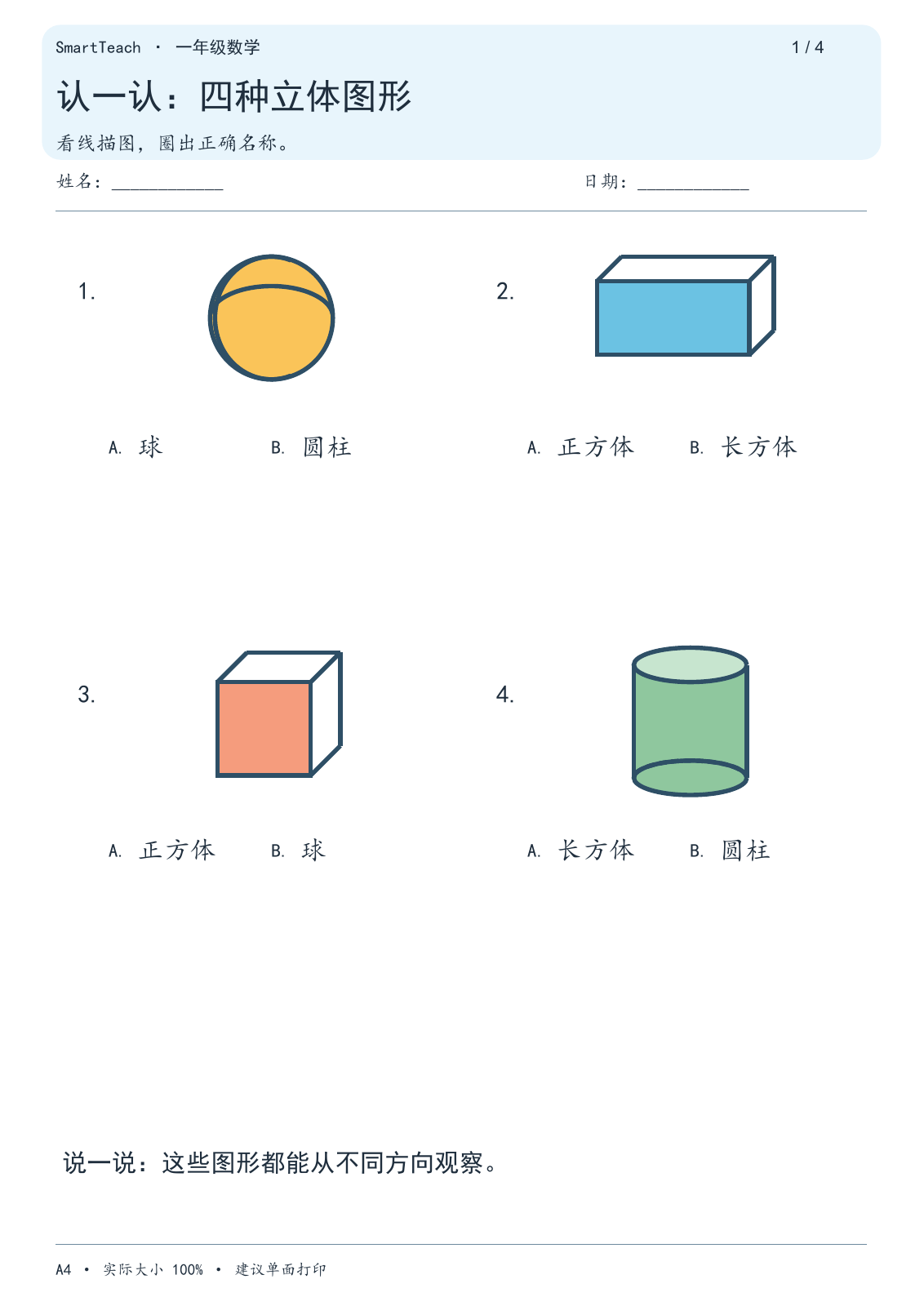
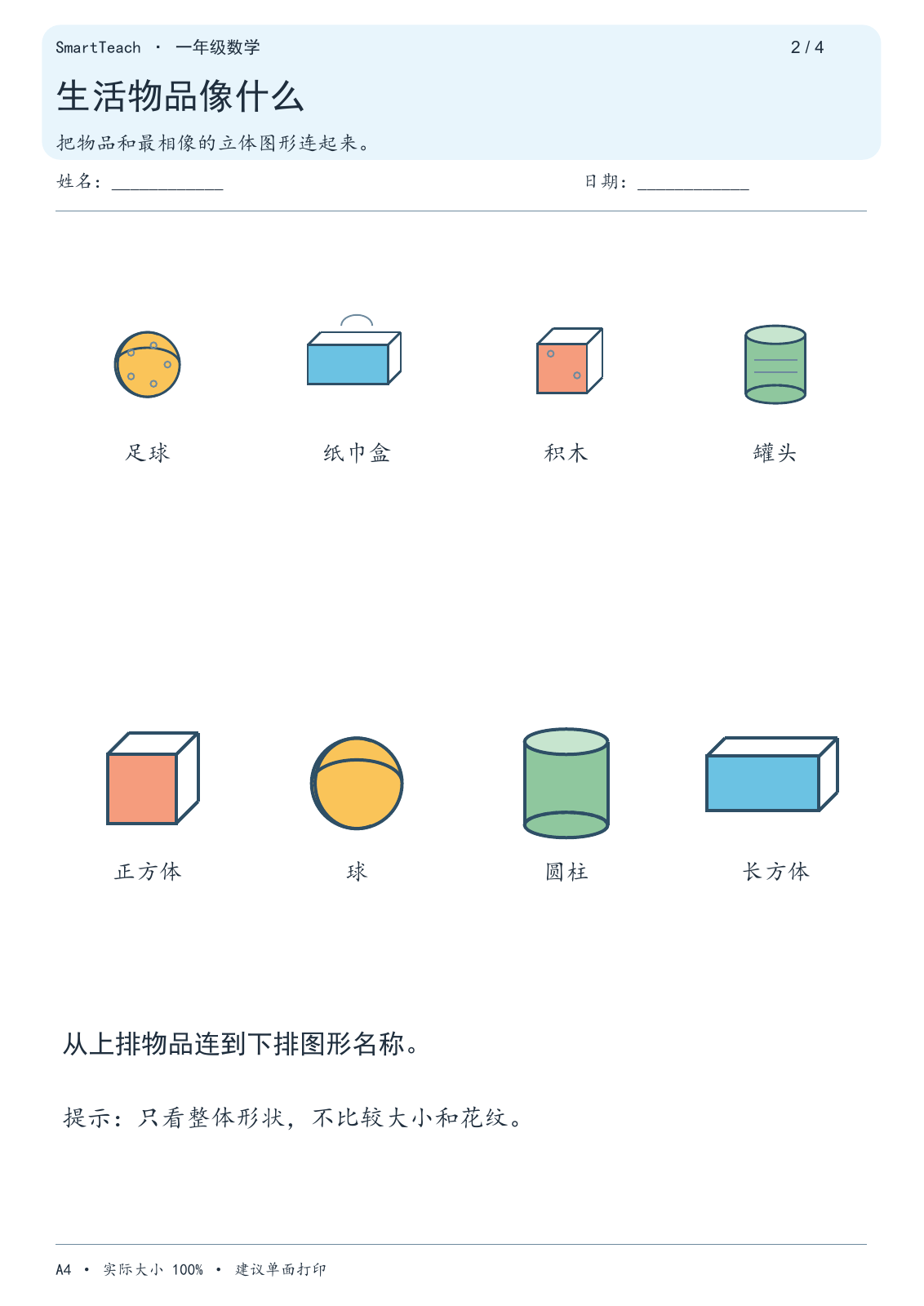
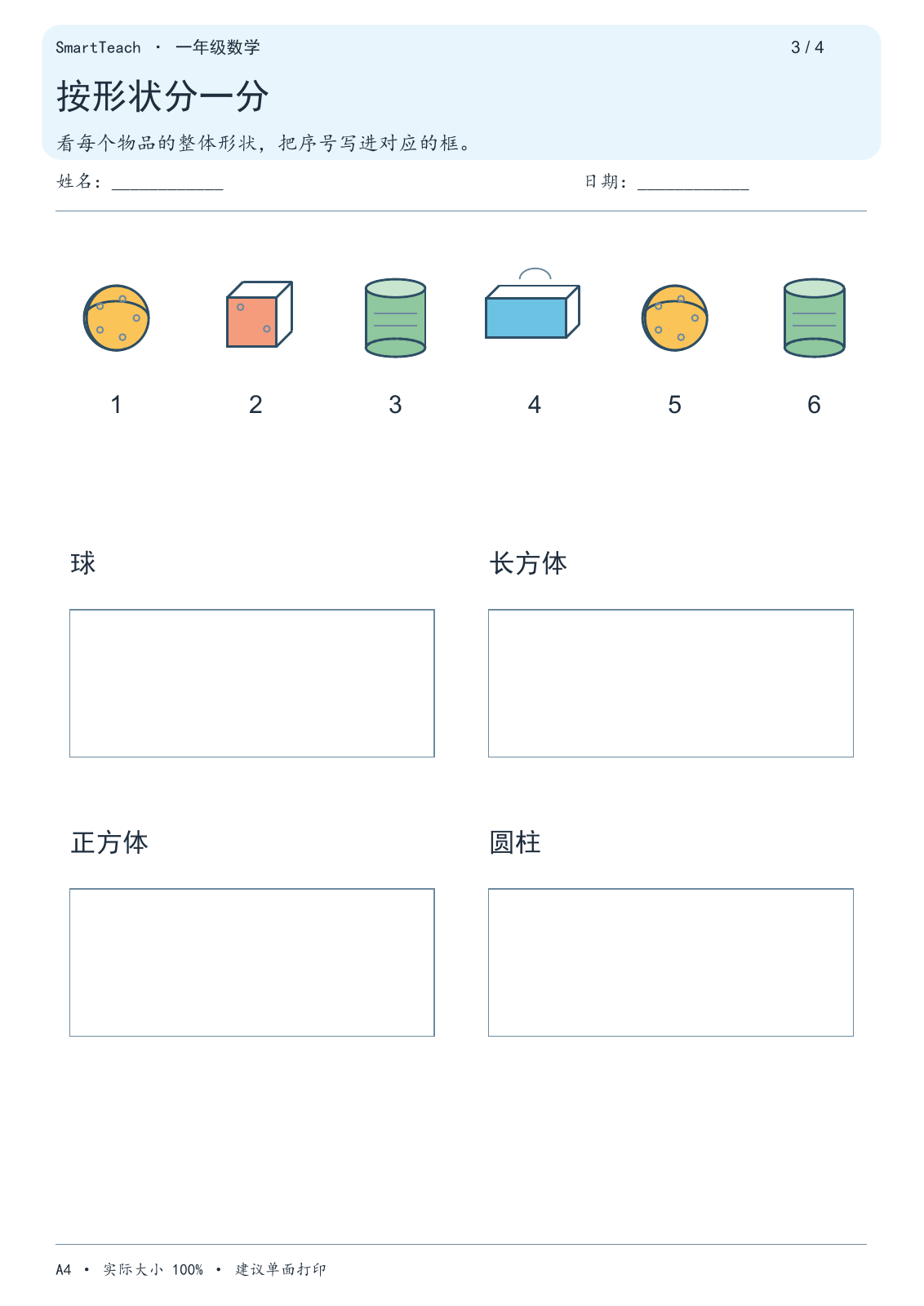
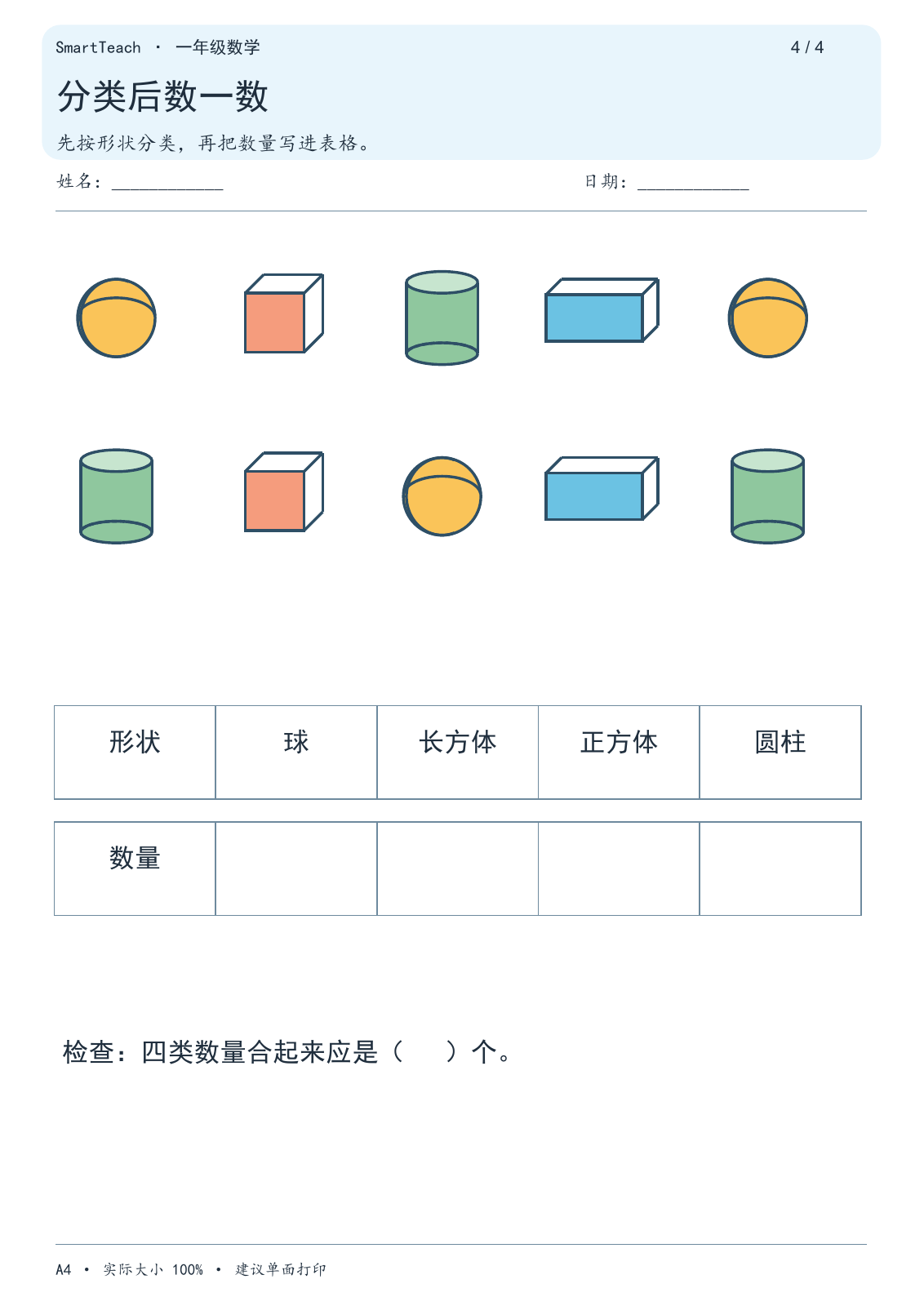
For printing, use A4 at 100% scale and print single-sided.